
Most people looking straight at a hail-damaged car see nothing. That is not carelessness, it is physics — a shallow round dent returns light almost the same way the flat panel around it does.
The technique
Get low and look along the panel, not at it. Crouch so your eye is nearly level with the surface and sight down its length. Dents appear as distortions in the reflection.
Use a straight-line light source. A fluorescent tube, a roof edge, a doorway — anything with a hard straight edge reflected in the paint. Where the reflected line wobbles, there is a dent. This is the entire principle behind professional PDR lighting.
Work in order so you do not skip anything: roof, then hood, then trunk lid, then each door, then the quarter panels, then the mirror caps.
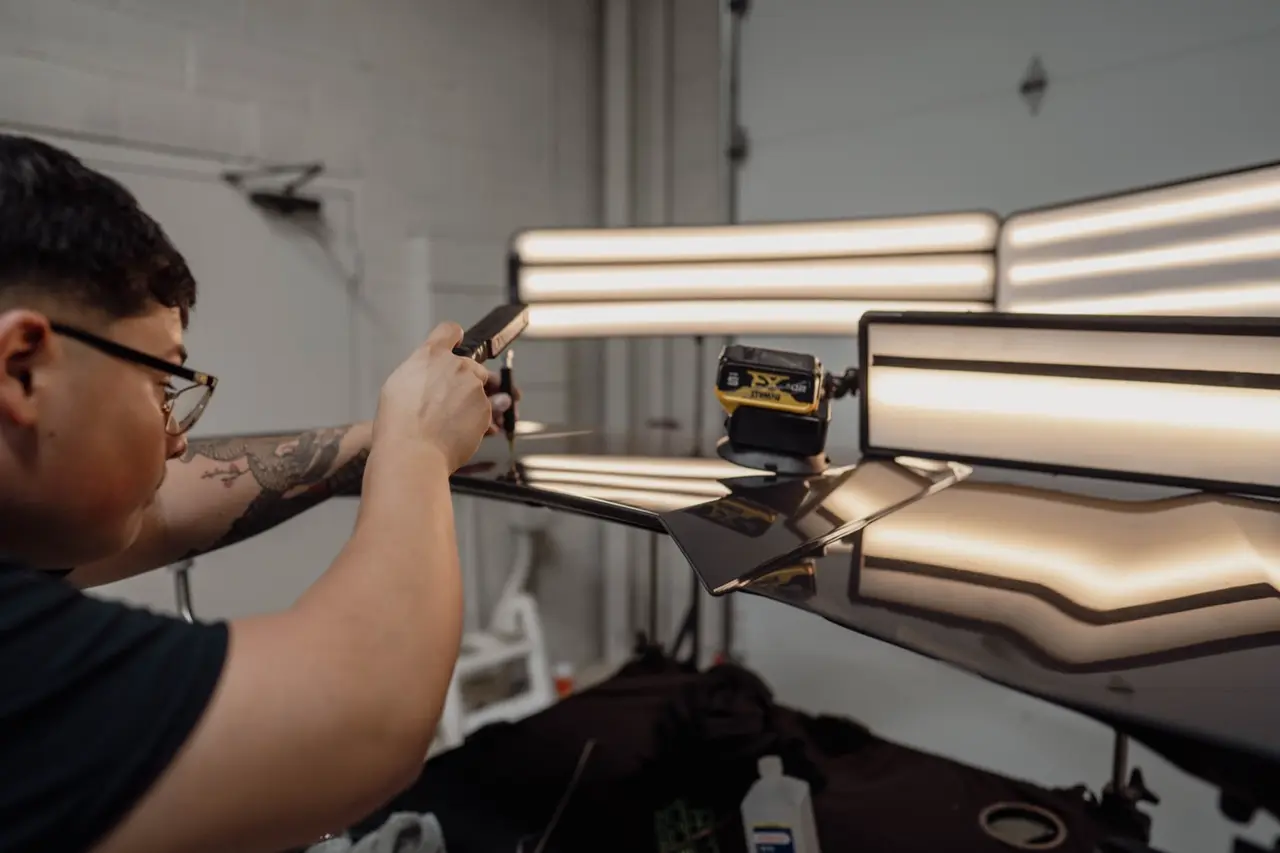
Where damage hides
- Sunroof glass and its surround. The single most missed item.
- Roof rails and the channel beside them.
- The trailing edge of the hood, under the shut line.
- Upper door frames, if there was any wind.
- Plastic trim and mirror caps, which crack rather than dent.
Why a daylight walkaround is not enough
Overcast daylight is diffuse. It throws no hard line for a dent to distort, so a walkaround in a parking lot routinely misses a large share of the damage.
That is the practical reason hail estimates have to be written under proper lighting, and the reason a photograph-based estimate almost always comes in short. Short estimates turn into supplements, and supplements stall your repair halfway through.
Buying a used car
Check the same way. Sight down each panel in good light, and bring a small paint depth gauge if you are serious — readings well above factory on the roof or hood indicate a refinished panel.
A hail car properly repaired with PDR is a fine purchase. One that was repainted is worth knowing about before you agree a price.
Schedule an in-person estimate if you want a vehicle read properly.