
We insist on in-person estimates and people reasonably ask why, when everyone else seems happy to work from photographs. Here is the actual reason.
Diffuse light hides dents
A shallow hail dent is a gentle curve in a flat panel. Under diffuse light — overcast sky, a shaded lot, a phone flash — the dent reflects light almost identically to the panel around it. There is nothing for your eye to catch.
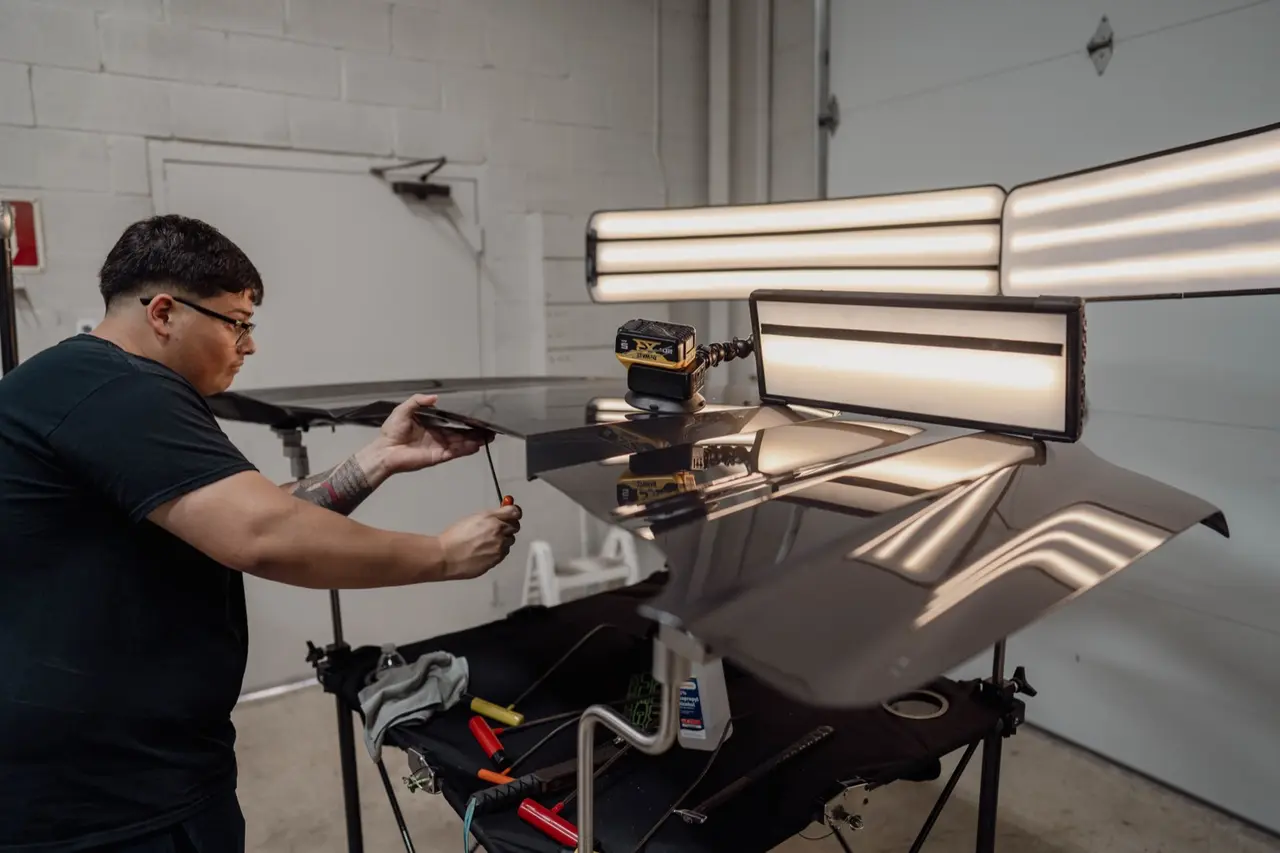
Under a hard straight-line source, the reflected line bends as it crosses the dent. Every dent announces itself. That is the entire basis of paintless dent repair lighting, and it is not a refinement — it is the difference between counting damage and guessing at it.
What a short estimate costs you
An estimate written in daylight or from photographs comes in under the real dent count. That has consequences:
- The repair stops mid-job while a supplement is written and approved
- Your car sits waiting for that approval, often days
- Your rental coverage burns during the wait
- The insurer has to re-examine a claim they thought was settled
None of that is hypothetical. Supplements are the single most common reason a hail repair takes longer than quoted.
What in-person gets you
- An accurate dent count per panel, not a lump sum
- An honest call on which panels need paint and which do not
- Glass and trim identified up front, including the sunroof
- A number you can hold someone to
What we will tell you
If a vehicle is not worth repairing, we will say so. If the damage is light enough that your deductible exceeds the repair, we will say that too. Neither conversation is possible from a photograph.
We travel to hail-affected regions, so the inspection happens near you rather than at a fixed shop. Schedule an in-person estimate and we will tell you where the nearest crew is working.